
5 March 2026
The world is burning and Micheál Martin is fulminating about price “gouging” in our energy market. Nary a word about the illegal war being waged by Netanyahu and his compliant bitch Trump. Shameful.

Picture of the Week
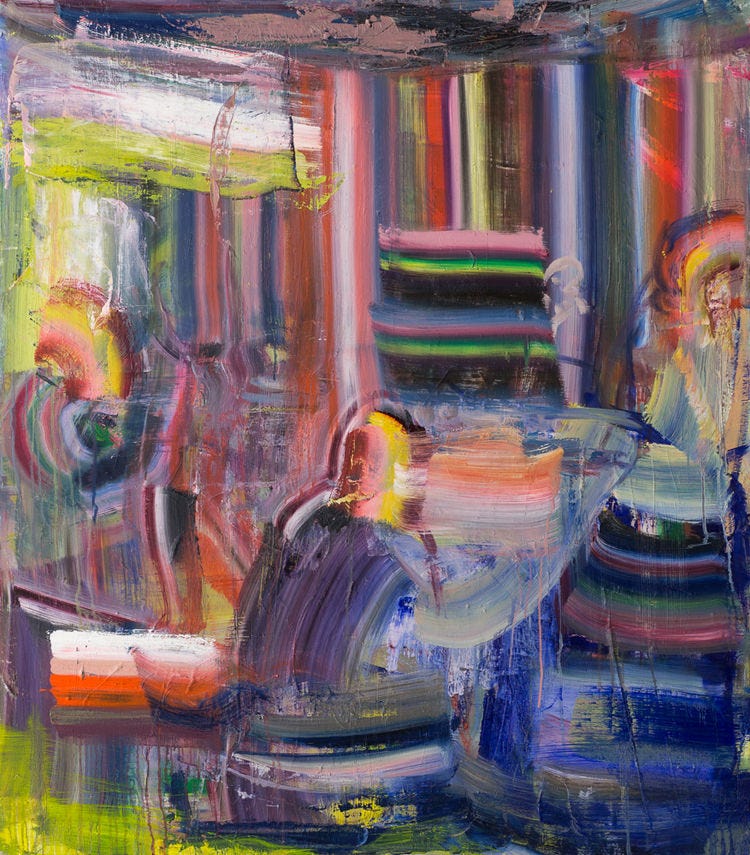
Diana Copperwhite (notwithstanding her surname) is not afraid of colour and her art over the years has been consistent in assailing our senses with great swathes of colour. No pointillism here. She doesn’t always capture the mot juste but when she does it makes for a powerful positive presence. I prefer the paintings that offer the occasional figurative clue (like this one - The Dissonance of Sequences)) rather than the more abstract pieces. Her current show at the Kevin Kavanagh Gallery runs until the 14th March.
The Moronic Inferno
I can’t remember who said it but one of the US pundits pointed out the other day that Netanyahu had been unable to find an American president stupid enough to fulfil his wet dream and unleash the whirlwind in Iran, until Trump came along. A conflict initiated without a plan - that is already impacting us all.
Bedtime Reading
Just finished Edward Chisholm’s A Waiter in Paris - it’s mildly diverting. Not quite Down and Out in Paris and London though there are echoes of Orwell’s classic. The author started his career as a “runner”, a step or two above the plongeur role made infamous by Orwell. A runner provides the link between the waiters and the kitchen - passing on the prepared meals. By the end of his stint at this restaurant he was a fully-fledged waiter with the occasional stab at he role of sommelier. It’s a slice of memoir with a fine line in rueful self-deprecation. It brings us up close to the inner workings of an upmarket Parisian restaurant with its rigid hierarchies and its behind-the-scenes liberties with the food. The author’s love affair with Paris is evident throughout and outside the restaurant he brings you to places unknown to the tourists: working men’s bars and cheap restaurants with authentic food.
Musical Interlude
Keepin’ Score by Mick Flannery
I was unfamiliar with Mick Flannery’s music but sequestered in West Cork on a wet Sunday afternoon this week, and eager to experience that storied venue Connolly’s of Leap, I went along to his gig. With my two daughters and a 10-month old baby. The venue was packed when we arrived at 13.30 but our warm and amiable hostess Eileen found us two seats and inserted us in a good strategic spot where we could both enjoy the gig and beat a hasty retreat if Indigo (the baby) started squawking. Flannery was a revleation, strong voice, diffident manner, mostly self-penned songs of regret and loss. Lyrically strong without any mawkishness. His general likability as a singer and a sound guy was confirmed for me by his concluding two songs, one by John Prine and the other by Tom waits.
A Morsel of Memoir
The Campfield where we lived during my school and college years was one of the highest points in Cork City and so was susceptible to lightning strikes. And there seemed, to my recollection, to be regular electric storms when we lived there. My mother was terrified of lightning and was quite content to pass this fear on to the rest of us. Upstairs in our house was a walk-in hot press – the only room in the house without windows. As soon as a storm threatened, the whole lot of us (except for my father who was usually playing golf or in the Officer’s Mess sipping pints when this occurred) would crowd in to the confined space to ride the storm out. This could take up to an hour and there really wasn’t much to do in there. On one infamous occasion I unearthed a peculiar glass device with a large red rubber bulb at the end of it – this was (as I discovered much later) a primitive form of birth control. You used it after sex to douche out the aspirant sperm. As my mother had seven children I suspect that it plain didn’t work.
My mother also had a morbid fear of spiders, a strange affliction for a country girl. This she duly passed on to all of us as well. There were regular piercing screams from some corner of the house where a child and an innocent arachnid had come into close proximity.
Livestock generally seemed to thrive in our house. There were slugs in the pantry every morning, spiders of all shapes and sizes, moths of exotic variety flew about and above all we had fleas. Our house had two dogs and at least two cats at any given time. They enjoyed free run of the house that meant they often used our beds for their greater comfort. Also, in a draughty house with no central heating a chubby Labrador was a decent hot water bottle. So fleas were a feature of most nights. They say that animal fleas don’t bite humans. That is bollocks. I used to wake up with big lumps on me from flea bites and spent many a post-midnight hour chasing the little critters around the bed. We all slept under army bulls-wool blankets that would snag them as they sought their escape. I kept a glass of water by the bed and would drop them in to drown them. Fleas are not expert swimmers. I would often wake up to find 5 or 6 corpses keeping me company.
Poetry Corner
A poem by Auden apt for our times.
September 1, 1939 by W.H. Auden
I sit in one of the dives
On Fifty-second Street
Uncertain and afraid
As the clever hopes expire
Of a low dishonest decade:
Waves of anger and fear
Circulate over the bright
And darkened lands of the earth,
Obsessing our private lives;
The unmentionable odour of death
Offends the September night.
Accurate scholarship can
Unearth the whole offence
From Luther until now
That has driven a culture mad,
Find what occurred at Linz,
What huge imago made
A psychopathic god:
I and the public know
What all schoolchildren learn,
Those to whom evil is done
Do evil in return.
Exiled Thucydides knew
All that a speech can say
About Democracy,
And what dictators do,
The elderly rubbish they talk
To an apathetic grave;
Analysed all in his book,
The enlightenment driven away,
The habit-forming pain,
Mismanagement and grief:
We must suffer them all again.
Into this neutral air
Where blind skyscrapers use
Their full height to proclaim
The strength of Collective Man,
Each language pours its vain
Competitive excuse:
But who can live for long
In an euphoric dream;
Out of the mirror they stare,
Imperialism’s face
And the international wrong.
Faces along the bar
Cling to their average day:
The lights must never go out,
The music must always play,
All the conventions conspire
To make this fort assume
The furniture of home;
Lest we should see where we are,
Lost in a haunted wood,
Children afraid of the night
Who have never been happy or good.
The windiest militant trash
Important Persons shout
Is not so crude as our wish:
What mad Nijinsky wrote
About Diaghilev
Is true of the normal heart;
For the error bred in the bone
Of each woman and each man
Craves what it cannot have,
Not universal love
But to be loved alone.
From the conservative dark
Into the ethical life
The dense commuters come,
Repeating their morning vow;
“I will be true to the wife,
I’ll concentrate more on my work,”
And helpless governors wake
To resume their compulsory game:
Who can release them now,
Who can reach the deaf,
Who can speak for the dumb?
All I have is a voice
To undo the folded lie,
The romantic lie in the brain
Of the sensual man-in-the-street
And the lie of Authority
Whose buildings grope the sky:
There is no such thing as the State
And no one exists alone;
Hunger allows no choice
To the citizen or the police;
We must love one another or die.
Defenceless under the night
Our world in stupor lies;
Yet, dotted everywhere,
Ironic points of light
Flash out wherever the Just
Exchange their messages:
May I, composed like them
Of Eros and of dust,
Beleaguered by the same
Negation and despair,
Show an affirming flame.