
4 September 2025
I tend to avoid conspiracy theories but I’m warming to the idea that Trump is a Russian asset. For a list of the ways he displays his flagrant support for the USA’s erstwhile enemy, see below.

Picture of Week
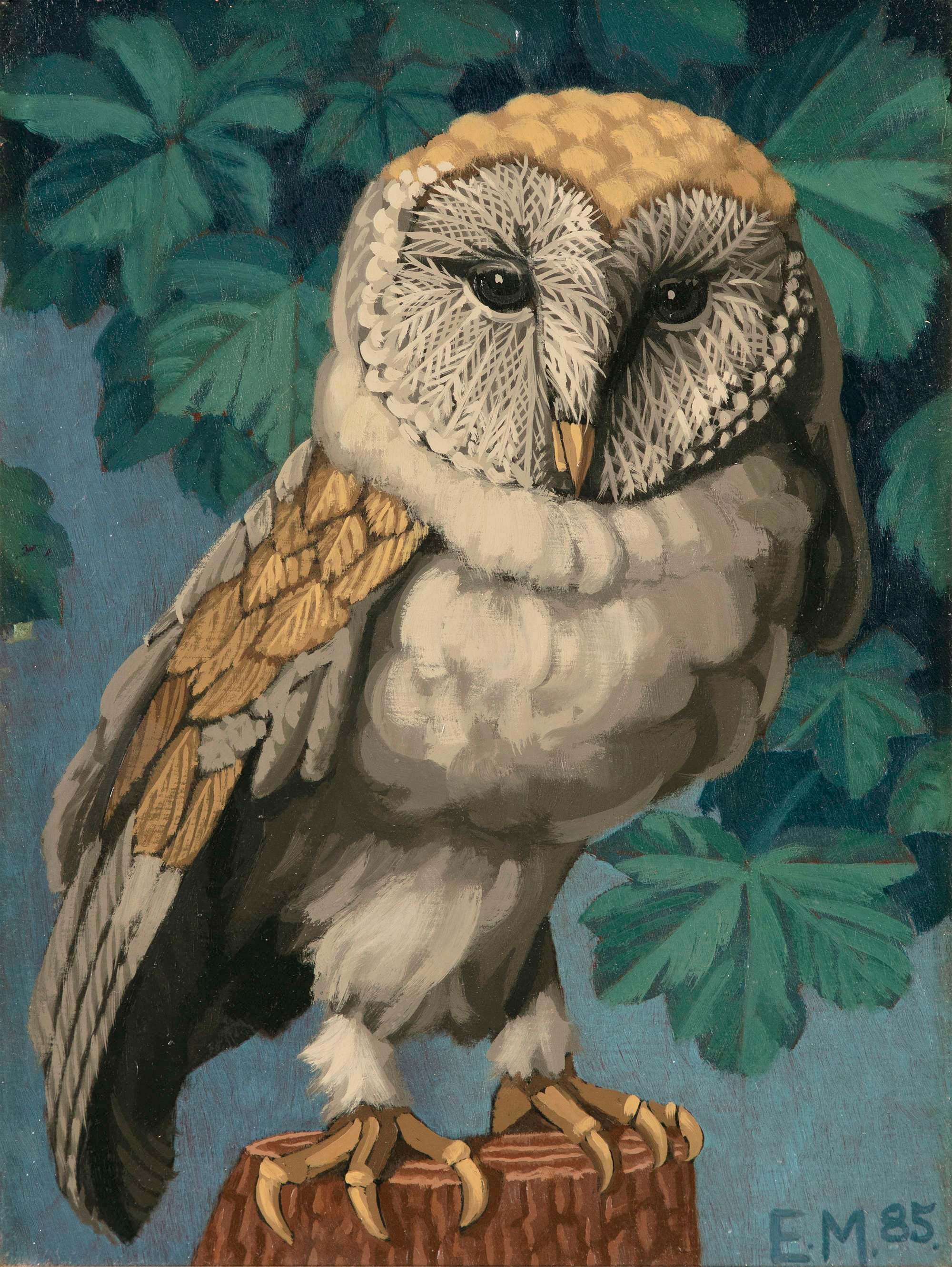
Edward McGuire (1932-1986) suffered from ill-health throughout his life and died at the relatively young age of 54 - not long after this painting was completed. He was a famously slow worker and usually managed about four paintings a year. As son of the owner of Switzer’s, perhaps the financial imperative wasn’t there. His famously bohemian lifestyle didn’t help either. He’s probably best known for his portraits (especially of poets): Seamus Heaney (four-square at his table with birds perched in the shrubbery behind), Paul Durcan and Michael Hartnett amongst others. He liked his birds and owned a number of stuffed ones acquired from the Natural History Museum in London. Barn Owl pictured here was amongst them. It’s on offer at Adam’s 24th September auction in Dublin, with a guide price of €15,000 to €20,000. An iconic image from an artist described by Irish Times critic Brian Fallon as our best portraitist since John B. Yeats (Jack and W.B.’s father).
The Moronic Inferno
It get’s worse doesn’t it. Competing gerrymanders, rearguard actions in courts, armed soldiers on the streets, hooded ICE agents acting with impunity, and the world economy wobbling. Also alarming is the number of ways he favours Russia - listed for us by Courtney Summers on Facebook. Here’s a taste but please read the full list.
🔥 The Full Russian Asset Breakdown
1. Multiple U.S. Intelligence Agencies Confirmed Russian Interference
•In 2017, 17 U.S. intelligence agencies jointly concluded that Russia interfered in the 2016 election to help Trump win.
•The Senate Intelligence Committee, led by Republicans, confirmed it again in 2020—Trump’s campaign had repeated contacts with Russian intelligence.
•Paul Manafort, Trump’s campaign chairman, gave internal polling data to Konstantin Kilimnik, a known Russian spy.
Glenn’s Carle – CIA National Intelligence Officer
“My assessment is that Trump is actually working directly for the Russians.”
— Glenn Carle, Newsweek, Dec 21, 2017
He flatly stated:
“Trump’s behavior cannot be explained by ignorance or even narcissism alone… it aligns too consistently with Russian strategic goals.”
🚨
Peter Strzok – FBI Chief of Counterespionage
Quote:
“I have been fired for expressing my personal opinion… about a dictator that history will soon deem not only a Russian asset but an unhinged madman threatening the sovereignty of the United States of America.”
What Strzok Saw:
Strzok’s conclusion was not just about personality—it came from watching Trump obstruct investigations, side with Putin over U.S. intelligence, leak classified info to Russia, and derail counterintelligence efforts from inside the Oval Office.
🚨
John Brennan (Former CIA Director)
“Donald Trump’s press conference performance in Helsinki rises to the level of treason. He is wholly in the pocket of Putin.”
— July 16, 2018, following the Trump–Putin summit in Helsinki.
🚨
James Clapper (Former Director of National Intelligence)
“The Russians, I believe, think they have a good feel for how to exploit President Trump. Whether witting or unwitting, he has become their asset.”
— May 2019, CNN interview on Trump’s behavior regarding Russian interests.
~~~~~~~~~~~~~~~
🇬🇧 United Kingdom Parliament & Intelligence Officials
♦️ MP Chris Bryant (Labour MP, Former Chair of Standards Committee)
“I think it’s entirely plausible—indeed likely—that the Russians have something on him. He has served Russian objectives again and again.”
— 2020, during House of Commons Intelligence Committee testimony.
♦️ Former MI6 Chief Sir Richard Dearlove
“Trump’s actions around NATO and Russia make us wonder whose side he’s on.”
— Referring to Article 5 hesitation and Trump’s threats to pull U.S. out of NATO.
~~~~~~~~~~~~~~~
🇵🇹 Portugal On August 27th 2025, a legitimately elected European head of state publicly and formally called President Trump a Russian asset.
♦️ President Marcelo Rebelo de Sousa bluntly declared, verbatim:
“The supreme leader of the world’s greatest superpower is, objectively, a Soviet or Russian asset. He functions as an asset.
**Objectively speaking, the new U.S. leadership has strategically favored the Russian Federation.”
~~~~~~~~~~~~~~~
🇪🇪 President Toomas Hendrik Ilves (Estonia, former)
♦️ Ilves Statement (2018)
“Trump is doing exactly what Putin would have scripted—undermining NATO unity, ridiculing allies, and emboldening Russia’s aggression. If he’s not an asset, he’s a gift.”
— In direct response to Trump attacking NATO members and praising Putin after Helsinki summit.
~~~~~~~~~~~~~~~
🇫🇷 President Emmanuel Macron (France)
♦️ Macron, after Trump questioned NATO and withdrew troops from Germany (2020):
“What we are currently experiencing is the brain death of NATO… [The U.S.] is turning its back on us. We can no longer rely on them for our own security.”
♦️ Macron, in reaction to Trump’s 2025 comments about abandoning NATO allies:
“Europe must prepare for a future where the United States chooses chaos. That chaos serves Russia’s ambitions, not ours.”
♦️ Macron, after Trump suggested abandoning Ukraine:
“A world where alliances are discarded and truth is manipulated is a world designed by autocrats.”
************************************************
8. He Undermined Ukraine at Every Turn
•Withheld military aid to pressure Zelensky into helping smear Biden.
•Spread Kremlin-aligned propaganda about Ukraine election interference (a known disinfo campaign).
•Delayed or denied arms shipments while Putin amassed troops.
You can’t claim to “stand with Ukraine” when you actively helped its invader.
************************************************
9. He Attacked NATO—Putin’s #1 Enemy
•Repeatedly threatened to leave NATO.
•Refused to reaffirm Article 5 (mutual defense clause).
•Called NATO “obsolete” and publicly weakened alliance morale.
Every single thing he did weakened Western unity—exactly what Putin wants.
And there’s more…
Musical Interlude
Don’t Worry Baby was written by Brian Wilson and Roger Christian and sung by Wilson. Its style owes something to Phil Spector who the Beach Boys hoped would produce it but he refused. They went on to convincingly replicate his style anyway. Later is was recorded by Ronnie Spector - an inferior version. It remains one of the most perfect pop songs ever produced.
TV Highlight
As one who spent three years working on oil-rigs around the world, I was particularly drawn to The Piper Alpha Story on BBC2. It’s an absorbing and horrifying account of what happens when an oil rig fails to control a gas leak and a blowout occurs. While there is a convincing enough visual recreation of the 1988 disaster, the focus is on the accounts of the traumatised survivors. The level of detail in their personal accounts of how they escaped the inferno (jumping into a burning sea, diving from the helicopter deck etc) is testament to how we can behave in extremis. There were 167 deaths and 88 survivors - many of whom had horrific burn injuries. There but for fortune.
Bedtime Reading
Waiting on the Moon by Peter Wolf is a gossipy trawl through his encounters with famous musicians from Bo Diddley and Muddy Waters to Bob Dylan and the Rolling Stone. Who is Peter Wolf you might ask, as I did when the book was recommended to me. He was lead singer (later fired) with the J Geils Band who opened for the Stones at Slane Castle in 1982. I was there but I can’t say he made any impression on me - and I never cared for the band. He seemed to have a capacity for getting on with all sorts on the music scene - particularly with touchy black musicians with overwrought senses of amour propre. Step forward Sly Stone. One of the acknowledgements in the endnotes is for Peter Guralnick - the much lauded biographer of Elvis. Wolf certainly doesn’t share Guralnick’s exhaustive and detailed methods. The book is a loose string of anecdotes that are augmented by extensive, if unconvincing, dialogue. Its detail would have demanded a tape recorder permanently on as he met these characters. Considering every encounter is fuelled by considerable amounts of alcohol, painstakingly detailed by Wolf, it’s remarkable that he can remember anything. There are amusing moments. Wolf was married to the famously difficult Faye Dunaway and while she was making Chinatown, Wolf took her to visit Jack Nicholson (her co-star) at his Hollywood home. Nicholson and his co-Dunaway went upstairs to “go through their lines” shortly after arriving. After hanging around for over two hours he shouted up to the couple to hurry on, but got no response. Another hour passed and still no sign of them so Wolf got the message and called a taxi and went home, flying back to his New York base later in the day. I’m not sure how naive you’d have to be to let your wife go upstairs with an infamous Lothario like Nicholson. It was weeks before he met Dunaway again. They were reconciled for a while but a further escapade involving the photographer Terry O’Neill led to a final split. The O’Neill incident involved a lot of broken cameras and lenses.
Poet’s Corner
I’ve always liked the bleak, apocalyptic tone of Meru by W.B. Yeats - and its sentiments surely fit the times we are living in. Egypt and Greece goodbye, and goodbye America.
Meru
Civilisation is hooped together, brought
Under a rule, under the semblance of peace
By manifold illusion; but man's life is thought,
And he, despite his terror, cannot cease
Ravening through century after century,
Ravening, raging, and uprooting that he may come
Into the desolation of reality:
Egypt and Greece, good-bye, and good-bye, Rome!
Hermits upon Mount Meru or Everest,
Caverned in night under the drifted snow,
Or where that snow and winter's dreadful blast
Beat down upon their naked bodies, know
That day bring round the night, that before dawn
His glory and his monuments are gone.
Artist’s Archive
The reclusive Paddy Graham is an outsider on the Irish art scene and so rarely encountered in person as to have acquired semi-mythical status. He is also a good old-style tortured genius in the eyes of many. Our very own Vincent Van Gogh. I had heard about him for many years before I actually met him – he barely shows up at his own exhibitions not to mind anyone else’s. Despite his reputation as a shy and elusive man, on meeting him in the lobby of the Royal Marine Hotel in Dun Laoghaire, I found him the easiest and most amiable of company. Our meeting was to discuss his career in general with specific reference to his impending show Away presented by John P. Quinlan at the Triskel Gallery in Cork in 2015.
Paddy Graham’s canvases are battlegrounds marked by the blood, sweat and tears he expends in the act of creation. Religious iconography, nudes, pages from sketchbooks, cryptic phrases, sacred hearts, gaping crotches, and traces of earlier endeavours jostle for position. Graham recounts with amusement a story about his early reputation in Dublin art circles. Confronted by one of his more fraught canvases in the Hugh Lane Gallery, a viewer confided to his companion: "poor Paddy, he's obviously very ill." This anecdote captures the common view at the time that Graham's often alarming and visceral paintings must be the incontinent spewings of a tortured psyche. He has had his darker moments certainly, struggles with alcohol and mental health but his art has many sources. Much of it has sprung from his extensive reading in philosophy, especially Martin Buber, Nietzsche and Kirkegaard. These influences have led him towards the great romantic subjects: sexuality, death, and religion. He believes that art "is part of an older history made by those who saw in the dark". His paintings are essays about being and nothingness - about the religious and sexual antics of his stricken subjects as they flail about against a bleak grey background that suggests the Midlands skies of his youth. In his current show Away at John P. Quinlan's gallery at the Triskel, Graham continues his broadcasts from the brink of the abyss. Note the Sacred Hearts, the agonised self-portraits, the poignant sketch of the family rosary, the blood-red nudes, and the recurring references to mysteries. The Lamb of God is in contention with the sins of the world.
Graham's career has been a triumph - far from the myth of it being blighted by his alcoholism and occasional incarceration. He's a hard-working, successful painter, with an international reputation, living in domestic harmony in Dun Laoghaire. (I bumped into him shopping with his wife at Tesco’s in Dun Laoghaire a few weeks after our interview). He has a keen interest in sport, especially rugby. (When we met he recounted, with the relish of a true fan, a recent encounter with Ciaran Fitzgerald.) He hasn't had a drink for nearly forty years and he paints every weekday. He's a member of Aosdana ("a peripheral one" he says) and has work in the permanent collections of both IMMA and the Hugh Lane Gallery. He's not a big fan of the RHA but showed there when invited by David Crone. He is an outsider however in his healthy skepticism about all art clubs, academies and associations. He refused to show at the Exhibition of Living art in its time and even became skeptical of the Independent Artists group, although he did show with them for a period. He maintains that "the new Academy is the old Academy, but just a little cleverer in the way it dresses and uses its voice in the very politicised world of contemporary art."
Born in Mullingar in 1943 his early childhood was marred by a series of family disasters. His father went to England when he was four and the family saw little of him thereafter. "Your father had a glint in his eye and was a rogue in his britches " Graham remembers being told years later by an old woman who stopped him in the street. His mother "scraped a living" for her young family for a while but then contracted TB and spent some time in a sanatorium. Graham was sent to live with his grand parents. He subsequently contracted rheumatic fever and became so sick that he couldn't walk and was confined to bed for nearly a year. In his confinement he became a voracious reader and started to draw using whatever materials came to hand. This reading habit and interest in art was carried on later with the help of an aunt who was the local librarian. He consumed books about art and artists. "When I was about ten I discovered Modigliani."
He went to school at the local technical college where his talent for drawing was spotted early by a sympathetic teacher, Dermot Larkin. Even now, talking to the artist more than 50 years later, his gratitude is palpable. He worked with Larkin every evening after class becoming in effect his apprentice. "Larkin taught me to be a watcher, a mixer, a colourist, a cartoon-maker and a scene painter. I remember copying Manet at 13." Graham's talents led him to achieve first place in Ireland in his Group Certificate art exam. Larkin was also influential in getting the precocious young artist a scholarship to the National College of Art. Blessed with painting skills and fluency of line, his prodigious natural talent meant he could already turn out effortlessly a polished academic study. He went straight from foundation year to second year. Money was tight with an absentee father, but Graham stuck it out and acknowledges the sympathetic support there of John Kelly and Maurice MacGonigal. He recalls his first visit to the life drawing class where the young country boy ran from the room in fright: "I hadn't seen a naked woman in my life." Such innocent days. He soon adjusted to his new environment and his path in life seemed set fair. "I was told by John Kelly that I'd be in the academy (RHA) by twenty-one."
But then came the fall. He recounts how an Emil Nolde exhibition came to Dublin and it revealed to the young painter the error of his ways. It showed him that art could be a vehicle for personal expression and that the academic painting was not real art at all. "I saw an Emil Nolde exhibition that absolutely destroyed me as a performer. I now knew I could no longer make art as a conscious aesthetic act." This revelation led to a cessation of painting and a general questioning. It also led to the pub. He discovered the delights of O'Donoghue's, Grogan's and McDaid's and spent endless hours debating the "what is art" question rather than exercising his talents. He met a wealthy American woman and they got together and revelled in the drunken bohemian life of Dublin in the Sixties. "It was", he recalls, "a great time for failed geniuses". His lost years followed and he did little painting between leaving art college in 1963 and 1974. "I was going in and out of mental hospitals". He remembers slipping into a coma in the Wicklow Hotel and being carried out to an ambulance. The breakthrough came in 1974 when a young psychiatrist suggested that he deal with his life as art: "make some drawings about your experiences here." He embarked on a series of studies of a patient called Joe and the resultant work became his first solo show at the Emmet Gallery. It was entitled "Notes from a Mental Hospital and Other Love Stories." He finally gave up the drink in 1978 and went from being one of the first patients at the Rutland Centre to becoming one of its mentors for alcoholics. He also met his future wife there. She's a psychologist and the artist maintains that "she's been a great source of balance and evenness."
His next tentative steps back into the art world came with the help of Trevor Scott who offered him some teaching hours at the Dun Laoghaire College of Art. He moved into a small studio in Royal Terrace West where a neighbour was the artist Brian Maguire. With Maguire's support he got into the Lincoln Gallery and began to show with the Independent Artists. A sympathetic review by Michael Kane helped the recovering artist on his way and soon he was a regular part of the Dublin art scene. His work however was difficult and not exactly designed for suburban walls, so sales were not great. He remained dependent on his teaching hours in Dun Laoghaire and later at DIT.
A chance occurrence in the early Eighties altered radically the trajectory of Graham's career. The actor and influential art collector Vincent Price came to Dublin on a cruise and was waiting outside the Lincoln Gallery one day when Leon De Sachy arrived to open it. He proceeded to buy three of Graham’s large paintings, removing them from their frames before he returned to his boat in the Alexandra Basin. Subsequently Price wrote to the artist and encouraged him to come to LA and show at the first LA International Art Fair, saying that "this stuff is essential for LA". Graham scraped together the money, aided by Vincent Ferguson from the Hendricks Gallery. He found himself at an enormous show amongst the elite of the international art world. His modest space at the periphery of the fair was ostentatiously favoured by Price and his extensive entourage, including his wife the actress Cora Browne. The attention of such a prominent collector did not go unnoticed. Graham was signed up by the Jack Rutberg gallery in LA and soon acquired a substantial following amongst the art lovers of that city. This is a rich seam of patronage that he continues to mine to this day, although sadly Vincent Price is long gone.
For a man who comes across initially as mild-mannered, even diffident, Graham has got some acerbic views on the Irish art scene and is not shy about expressing them. The provincialism of our artists is a particular bête noire. "They still retain the idea that if we imitate international art we become international. No. If you're from Mullingar, you're fucking international." Echoes there of another Patrick. And like Kavanagh, Graham mined his youthful experiences in rural Ireland to create art of universal import.
Postscript
Paddy Graham’s epic survey exhibition at the Hugh Lane Gallery in March 2022 demonstrated again to the world the depths of his vision. Sex, blood, religion and gnomic slogans fight for space on his large, tortured and desecrated canvases. The great and good from local government and from the Irish art scene gathered in great number in seeming celebration of the blood, sacrilege, rape and psychic mayhem that is his stock in trade. The Lady Mayoress made a fulsome speech and the crowd moved around respectfully examining the gory details of his art. Paddy himself was having none of it. As soon as the speeches were done, he shot out the door of the Hugh Lane and disappeared. There was no mingling with friends and admirers – he was out of there. Back to his haven in Dun Laoghaire.
Image is Barn Owl by Edward McGuire. This post includes Paddy Graham, Peter Wolf, Brian Wilson, W. B. Yeats and more.
I look forward to reading John P. O’Sullivan’s Cultural Manoeuvres every week.
His articles are truly cultural and informative and he tells it as it is with his wonderful command of our English language.
In this world we live in now this is sadly lacking.
In my opinion, there is a distinct lack of people informed culturally, politically etc. to follow Michael D to the Aras. Well here is an example!