
4 June 2026
Michael Flavin, Douglas Stuart’s John of John, Sean McSweeney, the Rocking Berries, a beautiful poem by Louis MacNeice and the folly of a young gambler.

Picture of the Week
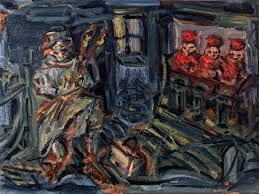
While working on an Irish Arts Review profile of Jim Flavin, the sculptor and founder of the Bronze Art foundry, I met his son Michael who has just completed a masters at the Belfast School of Art. His masters show is on view at the BB Building, Ulster University, York Street, Belfast from the 5th to the 20th June. He also has the painting above (excuse poor format) in the current RHA Annual Exhibition: Black Francis, Na Filidh & the Uileann Pipes. Shades of James Ensor for me but with his own absurdist twist and gothic flavour. A man to watch.
The Moronic Inferno
Let’s all have a good laugh today at the nonsense that the USA is planning major celebrations on the 4th July for the 250th anniversary of becoming an independent nation. It’s a country that is clearly owned by Israel and is in thrall to Russia and its own Information Technology overlords. Independent and democratic me bollocks. Meanwhile it’s funding the slaughter of innocents in Gaza, Iran and Lebanon at the behest of its owners.
Musical Interlude
The Rocking Berries were pretty much a one hit wonder. This Beach Boy’s influenced song, released in 1964, was a huge hit back then. It chimed perfectly with lovesick teenagers such as myself. They had some smart musicians, Chuck Botfield was the prime mover and Christine McVie (then Christine Perfect) once played keyboards with them. I had forgotten all about them until a few years ago when I walked into a club in Barcelona and He’s in Town was playing. I was brought back in time and enjoyed once again its pitch perfect pop perfection.
He’s in Town by the Rocking Berries
Art Archives
Yesterday was the anniversary of the death of Sean McSweeney (2 June 2018) as noted by David Britton is his always enjoyable and informative 20th Century Irish Art Facebook group. He was kind enough to include a piece I wrote on Sean a few years before her died. So in fond memory of that wonderful painter and most amiable of men, I include a link here:
Bedtime Reading
I have nearly finished John of John by Douglas Stuart and am finding it just as absorbing as Suggie Bain and Young Mungo - his two previous novels. Stuart’s books have the ability to immerse you in his chosen milieu and in the life of his characters, whether it’s working-class Glasgow or, as in this case, crofters on a remote Scottish island. The John of the title is a stern and ostensibly rigorous Calvinist minister and the main theme is the tension between this moralistic monster and his gay and frivolous son Cal. There are many other sub-plots and minor characters all brought to life by Stuart’s lively prose and eye for detail. The ludicrous religious restrictions of the Calvinist religion and its grim elders is given no mercy. I’m looking forward to the impending denouement. Engrossing, enjoyable and strongly recommended.
A Morsel of Memoir
Gambling Coups and A Great Disaster
Having been captivated at an early age on the Curragh with a winning bet on the Irish Derby (with my mother’s encouragement) and seeing gambling as a part of family life in the regular poker games, I became a lifelong devotee of the activity described by G.B, Shaw as “as getting nothing for something”. I attended CBC in Cork which conveniently had Donnelly’s betting shop across the road on MacCurtain Street, owned by a classmate’s father. Myself and my late and lamented buddy Donal Murray would usually manage a bet on the 2 pm race before classes began at 2.15. I was usually thinking about horses back then when I wasn’t thinking about girls. In those early days, I was quite happy to share my knowledge (such as it was) - a practice I strictly avoid now. On one auspicious occasion (1963), I tipped the winner of the Lincoln and the Grand National to my classmates. Most of them had a shilling each way on a horse called Monawin that won the Lincoln at 28-1 - with the great Joe Sime on board I was a hero for weeks afterwards. With the Grand National coming up not long afterwards, they looked to the Oracle again. I initially told them to back Ayala at 66-1. The day before the race I changed my mind and deflected them onto a horse called Hawa’s Song – a 28-1 shot. The awful inevitable happened. Ayala won at 66-1 and I hadn’t a penny on it. My choice, Hawa’s Song came third at 28-1. Oh the remorse – even though we all made place money. One boy, missed the change of selection and actually backed Ayala. He was a small, buck-toothed boy – very low in the class pecking order. I bullied him into giving me five shillings from his considerable winnings. Still feel bad about that.
Prior to this my role as class expert on sporting matters had taken a major battering in the boxing ring. The first fight between Cassius Clay (as he was then) and Sonny Liston had Clay as a 10-1 against outsider. It was fashionable to like Clay, and fancy the good-looking underdog against the ugly, possibly criminal, brute Liston. I reckoned I could use this misplaced fervour for my own profit and so I acted as bookmaker for about fifteen of the class – the average bet was a shilling at 10-1. I stayed up until four in the morning to listen to the fight – the horror didn’t take long to unfold as Liston proved to be a stumblebum rather than a champion. The next morning I dragged myself unwillingly to school. As I walked into the classroom the entire class rose, some stood on their seats, and cheered. Cruel boys.
I spent about 4 weeks paying them off – in strict order of their place in the class pecking order. The rugby heroes first, the swots next and the small and misshapen last of all. This was where I learned that there is no such thing as a certainty.
Poetry Corner
The Sunlight on the Garden - a beautiful poem about aging by the sorely neglected Louis MacNeice:
The Sunlight on the Garden
The sunlight on the garden
Hardens and grows cold,
We cannot cage the minute
Within its nets of gold;
When all is told
We cannot beg for pardon.
Our freedom as free lances
Advances towards its end;
The earth compels, upon it
Sonnets and birds descend;
And soon, my friend,
We shall have no time for dances.
The sky was good for flying
Defying the church bells
And every evil iron
Siren and what it tells:
The earth compels,
We are dying, Egypt, dying
And not expecting pardon,
Hardened in heart anew,
But glad to have sat under
Thunder and rain with you,
And grateful too
For sunlight on the garden.