
14 August 2025
Anas al-Sharif: I entrust you with Palestine – the jewel in the crown of the Muslim world, the heartbeat of every free person. I entrust you with its people, with its wronged and innocent children.

The Moronic Inferno
When you read the final words of murdered journalist Anas al-Sharif above, do bear in mind that everything that’s happening in Gaza and on the West Bank is done with the USA’s very active collusion. And with more modest support from the other, ostensibly horrified, Western powers. “Silence is complicity” was one of al-Sharif’s last utterances. Note the total absence of comment from the USA on the murder of these journalists - few now left to bear witness to this new Holocaust. And what the fuck is Starmer up to in the UK, arresting grannies for waving pro-Palestine flags. The time however for outraged comment has surely well passed and the remnants of the civilised world must act. Do something: embargoes, financial punishments, or widespread sporting bans - the latter would be a good, high-profile start. Here in Ireland we are full of righteous indignation but our chicken-shit FFG ruling party has actually done nothing but talk - notwithstanding the massive support for Palestine here. They’re great talkers all - whether its about housing, health or Holocausts. The murmurs about the financial repercussions if we act on Gaza is despicable - are we that easily bought.
I notice that Bono has been stirred to action and has written a measured piece in the current edition of The Atlantic. Here’s an extract:
There is no justification for the brutality he and his far-right government have inflicted on the Palestinian people, in Gaza or in the West Bank. And not just since October 7—well before it, too, though the level of depravity and lawlessness we are seeing now feels like uncharted territory.
Curiously, those who say these reports are not true are not demanding access to Gaza for journalists, and they seem deaf to the revealing rhetoric. Examples that sharpen my pen include: Israel’s heritage minister claiming that the government “is racing ahead for Gaza to be wiped out”; its defense ministerand security minister arguing that no aid should be let into the territory; its finance minister vowing that “not even a grain of wheat will enter the Strip.” And now Netanyahu has announced a military takeover of Gaza City, which most informed commentators understand as a euphemism for the colonization of Gaza. We know the rest of the Gaza Strip and the West Bank are next. What century are we in?
For more up-to date analysis of how far down the road to dictatorship the USA has gone, I would check out Andrew Sullivan’s Substack - The Human Stain - on this platform.
Picture of the Week
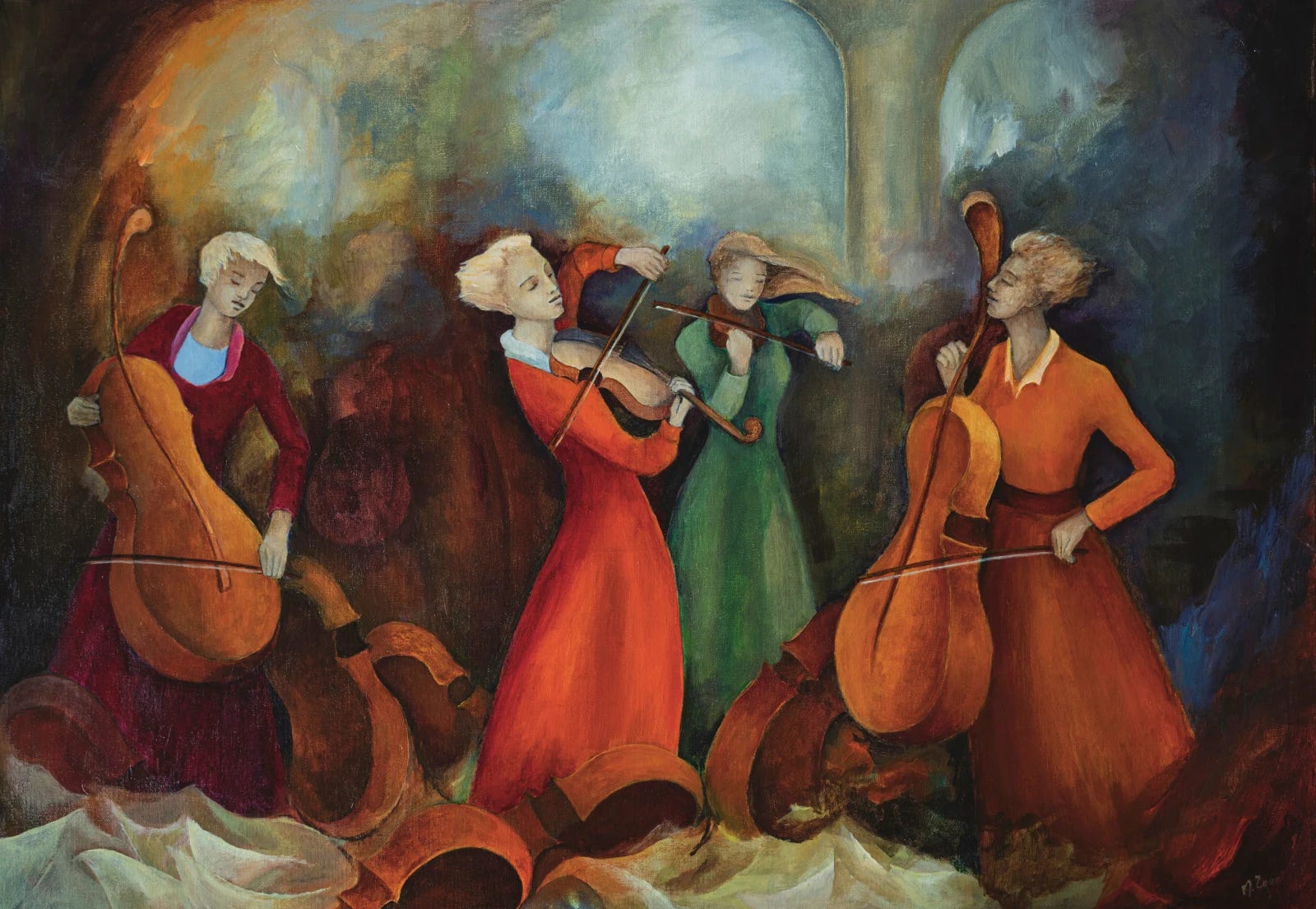
Margaret Egan’s Drawing in the Glorious Sound: On view at the Solomon Gallery’s Summer Show until the 23rd August. Egan has been on the go for many years and consistently produces lushly-coloured and beautifully composed paintings. Not rocking the boat perhaps but certainly entertaining the eye. There are two distinct threads in her work: the stylised figurative paintings (as illustrated above) and those warm, misty landscapes that confirm her affection for Turner.
Musical Interlude
Buddy Holly was my first musical love - encountered on the old Radio Luxembourg sponsored programs back in the late 1950s - along with Elvis, Little Richard, Fats Domino, Jerry Lee Lewis and Chuck Berry. His plangent love songs struck a chord with an adolescent boy and still stir memories of that fraught time. This song was released in 1961 - after his death and was written on the breakup with his school sweetheart - the wonderfully-named Echo McGuire. She was a girl more inclined to religion than rock and roll and split with him on this account.
Nighttime Viewing
In the past week I have finally caught up with two films on RTE that should be still available on the RTE Player. I had read and enjoyed John McGahern’s That They May Face the Rising Sun a few years ago and thoroughly enjoyed its depiction of rural life in the 1980s. The film version by Pat Collins surpasses that experience with the leisurely pace, the social nuances, the beauty of the locale, and the very fine acting. Nothing much happens - chat and banter and a fuss over a funeral. Collins even took the daring step of omitting John Quinn from the film - a brutal womaniser who shockingly humiliates his bride on their wedding day. the actor Lalor Roddy steals the show as the troubled and contentious Patrick Ryan. His energy and suppressed rage dominates every scene in which he appears. I haven’t seen him before but apparently he has had a distinguished stage career, including a period with the RSC in Stratford. I’ll certainly be looking out for him when he next appears on stage. Sean McGinley was also excellent as the sad, exiled Johnny.
Another gem on RTE last week was Luke McManus’s North Circular which I watched with increasing admiration for the second time. An elegiac trip along that road from the Phoenix Park to the Docks that encompassed the young and vibrant scene around the Cobblestones pub and garnered some disturbing memories from former residents of St. Brendan’s, Grangegorman - an old school lunatic asylum in its day. The whole trip punctuated by a memorable musical score with some gloriously atmospheric filming (that old church) - all in black and white.
Sporting Highlights
I can’t claim to have watched the All-Ireland camogie final between Cork and Galway but I was impressed when I watched the highlights on the news by the remarkable last-minute winning point from a side-line free by Galway’s captain Carrie Dolan. The same woman had been felled earlier by Hannah Looney (a moment of madness) with a blow to the head. The consequent red card just before half-time gave Galway a crucial numeric advantage. Cork were once again very hot favourites (like its hurlers a few weeks back) so the malaise by the Lee is deepened.
Bedtime Reading
Finally got Caledonian Road by Andrew of Hagan finished. I’m not sure I’ll jump into a 700-page novel again soon. Even starting a very long novel seems presumptuous at this stage. I gradually grew into this one and O’Hagan’’s descriptions of the creatures who inhabit the rarified fine art world, exemplified by the annual Frieze exhibition, was worth the price of admission. Dickensian in its cast of colourful characters and Swiftian in its invocation of the last dying fart of the British Empire.
Artists’ Archive - Robert Ballagh
I first saw Robert Ballagh in the fabled Arcadia ballroom in Cork in the mid-60’s. He was playing bass with the Chessmen – one of the more accomplished and musically sophisticated of the show bands in that era. The bespectacled bass player made little impression on me at the time as we were more focussed on the charismatic, Jagger-like lead singer Alan Dee. Ballagh exited the demanding showband life not long afterwards and the next time I heard of him was as a new kid on the block in Irish art with his graphic style and often political content. Over the years he has been one of the few Irish artists to engage in public discourse about the neglected state of the arts in Ireland and to canvass for improvements in the artists' lot. The implementation of the droit de suite being one of his more notable achievements. He is an intelligent and independent figure and has written an excellent autobiography which outlines in immodest detail his manifold achievements. I run into to him frequently at art events and in his local, Cumiskey’s, just around the corner from his home in Stoneybatter. This profile uses source material from my conversations with Ballagh and from his autobiography. A belated celebration of his 80th birthday was held at the James Gorrey Gallery in April 2024.
Robert Ballagh’s journey as an artist began by accident when he bumped into Micheal Farrell in Toner’s Pub on Baggott Street. (Ballagh suggests that the unusual spelling of Farrell’s first name was due to his dyslexia). “If I hadn’t met Micheal Farrell (that particular night in Toner’s, I’m pretty sure my own life would have drifted in an entirely different direction.” Farrell, an established artist at that time, had accepted a commission for a mural that stretched his capabilities and needed an assistant to bring it to fruition. “I’ll pay you a fiver a week and all the drink you can take.” Ballagh accepted and this encounter proved the apprenticeship that set him on his way as an artist. He was introduced to acrylic paint and learnt the uses of badger brushes and masking tape. His early exemplars were Warhol and Roy Lichtenstein and he learnt, when taking on an important portrait commission, that his initial dearth of drawing skills could be overcome by judicious use of a camera and the silk-screen process. Ballagh’s skills have developed over the years and the put down by Declan McGonagle that he was “a mere illustrator” is belied by much of his later work including the impressive series of self-portraits he did for the Wexford Opera Festival. These were inspired by his love of Rembrandt’s late self-portraits. In addition to his artistic talents, Ballagh is a master craftsman and can turn his hand to set design, carpentry and cabinet making.
Although his politics are of the left, Ballagh has friends and patrons on all parts of the ideological spectrum. Dermot Desmond is one of his main patrons and he’s done portraits of Charles Haughey and Fidel Castro, of Gordon Lambert and Noel Browne, and even of the Nobel prize winner Francis Crick. He’s not one to kick those whose reputations have suffered since he encountered them. While deploring Haughey’s corruption and hubris, he enjoyed their social encounters and gives him credit for his favorable treatment of artists and for his free travel scheme for the elderly. He also speaks warmly of his time at the Gate Theatre working with Michael Colgan. A less enjoyable encounter there was a run in with that monstre sacré Stephen Berkoff while designing Salome.
He confirms the creepy machinations of Fr. Donal O’Sullivan who was director of the Arts Council from 1960-1973 and was infamous for his partisan patronage. O’Sullivan blocked an invitation for Ballagh to show in Sweden by telling the Swedish curator (completely without foundation) that “he’s a chronic alcoholic and can become quite violent”. Ballagh achieves a piquant revenge by telling us that this ostensibly discerning authority on art lived in the Jesuit community house in Leeson Street for many years and failed to recognize that there was a Caravaggio (The Taking of Christ) on the dining-room wall.
A slightly edited version of the review below appeared in the Sunday Times Culture magazine on 21 October 2018.
The first surprise here is the title. Robert Ballagh is not a shy, nor a self-effacing man. He’s never been coy about promoting his work or telling his life-story, and he’s well known for his uninhibited contributions to the public discourse on topics such as the droit de suite for artists and the 1916 celebrations. However, we get an explanation for this seeming coyness on the first page: “only self-indulgent pricks write memoirs” he avers. But he has decided to overcome his reservations “so that future generations can have the full facts”. There’s something a tad presumptuous about this latter statement but fortunately it is at odds with the trenchant and unprecious attitude that characterizes the rest of this handsome and well-illustrated book.
The book is mostly an amiable canter through his career, with reflections on art, anecdotes about the characters he meets, and observations on Irish life. Those who consider Ballagh a rabid republican will find little of a seditious nature. He seems a republican primarily in the French Revolution sense and no reasonable person could argue with his comments on how our 1916 Rising has failed to deliver in terms of liberty, equality and fraternity. Ballagh is no working-class hero by background. He went to school at Blackrock College and his father played cricket and tennis for Ireland, and rugby for Leinster. His mother played hockey for Ireland.
The book opens with bang: a description of a vicious assault eight years ago and the ineffectual Garda response. It is followed by an account of his brush with cancer that was detected during tests for his injuries. After these encounters with mortality it settles down into a more or less chronological account of his career, with ample illustrations. There are lacunae and the book could have done with a judicious pruning. I’m not sure we needed as much detail on the technical aspects of producing stamps and banknotes.
There are occasional domestic episodes: an idyllic winter in Ronda, Southern Spain with his family is described – including his encounters there with the estimable Hilly Kilmarnock, the first wife of Kingsley Amis. And we learn of the warmth and strength of his relationship with his late wife Betty. He gives her credit for both intellectual and emotional support and they were clearly a very happy couple. “We were an enduring partnership. In the course of almost four decades as an artist, I can’t think of a single picture of mine that wasn’t improved by constructive comment by Betty.”
This memoir paints a picture of a contented man who has worked hard, was blessed with a good marriage, and has enjoyed a varied and successful career. He has a final word for the likes of McGonagle and O’Sullivan with his painting The Illustrator (shown on the back cover). It depicts Ballagh wearing a t-shirt declaiming: Fuck the Begrudgers.
Poetry Corner
I know T.S. Eliot is probably out of fashion these days, but along with Yeats, Auden, and Larkin, he’s one of the 20th century poets to whom I keep returning. Four Quartets is always a pleasure. Footfalls echo in the memory for sure. Here’s the opening section:
BURNT NORTON
(No. 1 of 'Four Quartets')
Time present and time past
Are both perhaps present in time future,
And time future contained in time past.
If all time is eternally present
All time is unredeemable.
What might have been is an abstraction
Remaining a perpetual possibility
Only in a world of speculation.
What might have been and what has been
Point to one end, which is always present.
Footfalls echo in the memory
Down the passage which we did not take
Towards the door we never opened
Into the rose-garden. My words echo
Thus, in your mind.
But to what purpose
Disturbing the dust on a bowl of rose-leaves
I do not know.
Other echoes
Inhabit the garden. Shall we follow?
Quick, said the bird, find them, find them,
Round the corner. Through the first gate,
Into our first world, shall we follow
The deception of the thrush? Into our first world.
There they were, dignified, invisible,
Moving without pressure, over the dead leaves,
In the autumn heat, through the vibrant air,
And the bird called, in response to
The unheard music hidden in the shrubbery,
And the unseen eyebeam crossed, for the roses
Had the look of flowers that are looked at.
There they were as our guests, accepted and accepting.
So we moved, and they, in a formal pattern,
Along the empty alley, into the box circle,
To look down into the drained pool.
Dry the pool, dry concrete, brown edged,
And the pool was filled with water out of sunlight,
And the lotos rose, quietly, quietly,
The surface glittered out of heart of light,
And they were behind us, reflected in the pool.
Then a cloud passed, and the pool was empty.
Go, said the bird, for the leaves were full of children,
Hidden excitedly, containing laughter.
Go, go, go, said the bird: human kind
Cannot bear very much reality.
Time past and time future
What might have been and what has been
Point to one end, which is always present.