
11 December 2025
The Health Service Executive did not offer an enhanced influenza vaccine for people aged 65 years and older this season as it was not deemed cost-effective. Now read on.

Picture of the Week
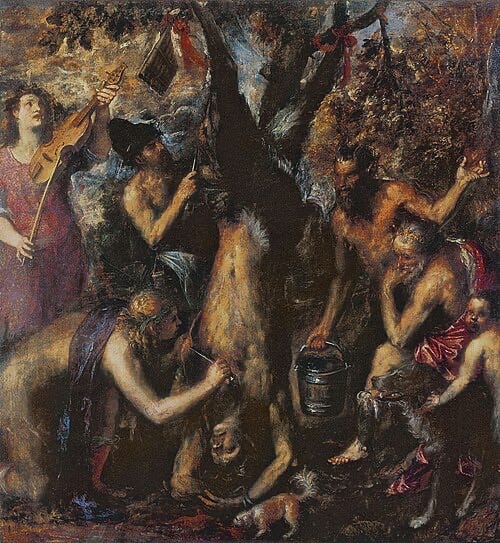
The Flaying of Marsyas is one of my favourite paintings by Titian and including any work by the Venetian genius needs no justification. I still recall his epic exhibition in the National Gallery 20 odd years ago (his portrait of a bloated Herod and his moving Ecco Homo standing out. However, lying in bed at the moment suffering from a virulent dose of ‘flu I’m identifying strongly with the unfortunate satyr in this painting. My suffering was not caused by offending Apollo but by the short-sightedness of the HSE who promoted an inferior vaccine on cost grounds and are now dealing with a full-blown ‘flu epidemic.
But back to my suffering: throat so sore that every swallow feels like chewing barbed wire, every cough (and I’m coughing constantly) sends a sharp dart of pain across my diaphragm, and I have barely the energy to haul myself to the bathroom. This is after four days in bed - sleeping fitfully. I’m blessed to have my dogs with me but unfortunately there’s no blood for them to lick up. Unlike the opportunistic little fellow at the bottom of Titian’s masterpiece. Titian has included himself in this macabre event - he’s the benign old man observing on the right,
The Moronic Inferno
This week I’m averting my gaze from the continuing destruction of American Democracy and bringing you instead a beautiful little essay, Lonesome Neon, by Oliver Kornetzke from Substack. Normally I’d only post an extract here and refer to Oliver’s post on Substack, but I know that people tend not to bother so I’m posting the whole lot - it’s so good.
“There’s a certain pull to a place like this—some half-forgotten bowling alley bar off a snowy highway in the middle of nowhere. The kind of place that feels like it’s been sealed in amber since the late ’70s or early ’80s, though I wasn’t alive to see them. It’s winter, just before Christmas, and the streets outside are silent save for the howl of a relentless snowstorm. The glow of faded, kitschy Christmas lights clings stubbornly to the chipped facades of shuttered storefronts, their windows frostbitten, their interiors dark. It’s a town long left behind, a relic of a different time.
Inside, the bowling alley is dimly lit, its scuffed wood lanes glowing faintly under flickering fluorescent lights. The smell is an unmistakable mix of waxed lanes, stale cigarettes, and cheap beer. Somewhere in the background, the mechanical rumble of a ball return mingles with the clatter of pins falling—sporadic, as if the lanes see more ghosts than regulars. The bar sits at one end, tucked away in the corner, an afterthought as much as a centerpiece. Its Formica countertops are edged in aluminum trim dulled with age, and the barstools are vinyl, cracked at the seams. A faded Schlitz neon sign hums faintly above the shelves, bottles lined like forgotten soldiers, their labels worn smooth by decades of indifference.
The jukebox is alive but temperamental, playing a tinny version of an old country tune or maybe something soft and melancholic from the early ’80s. Old Man by Neil Young, maybe. Locals, maybe three or four at most, sit scattered in booths or slouched over the bar. A few exchange muttered conversations while others stare into their drinks as if seeking answers. Someone leans against a pool table at the back, chalking their cue under a dusty Budweiser sign. The lanes themselves are empty, and their glossy surfaces stretch into the dimness like a memory fading at the edges.
It’s the kind of place where time feels porous. I’ve only ever been somewhere like this once or twice, but its memory lives in my mind like a myth. There’s a peculiar comfort in the isolation of it all—physical, yes, but more so mental. Here, it’s easy to be entirely present while slipping into another time, another place, another self. You drink not to forget but to summon the past, to let the burn of whiskey unfurl memories you’d rather leave buried but can’t resist revisiting. It’s a masochism that feels almost holy—self-destruction wrapped in the quiet sanctuary of vinyl booths, dusty lanes, dartboards, and the glow of cheap Christmas lights still clinging to a world that has long since moved on.
There’s a dichotomy to the life I live, an endless tug-of-war between the person I strive to be and the shadow that lingers, content to simply exist. On one hand, I hunger for growth—for knowledge, for progress, for the infinite wonder that science and technology offer. There’s a thrill in the pursuit of the intellectual, in pushing the boundaries of what I can understand, create, or achieve. But even with that drive, even with the thrill of discovery, there are moments when all I want—no, need—is to sink into the quiet oblivion of a place like this, ashtray at my side, a pack of Marlboro Reds within reach, and a whiskey on the rocks sweating lightly in my hand.
It isn’t escapism, not in the way some might think. It’s not about pity or some unspoken hope for rescue. It’s about the act of sitting there, utterly still, lost in the infinite, immeasurable depths of my own thoughts. Thoughts that ebb and flow, like waves against the rocky edges of memory. Some memories are jagged, ones I’d give anything to forget, yet they surface anyway, unbidden and sharp. Others I cherish so much they ache—so perfect, so fleeting, that to recall them feels like a wound you press on just to remember it’s real. And then there are the thoughts that simply are: emotions I can’t quite name, images I can’t quite place, floating in and out of focus like smoke curling lazily above a forgotten ashtray.
In those moments, as the whiskey takes hold and the edges of reality soften, something deeper begins to unfold. The memories blend, overlapping and bleeding into one another, and faces begin to emerge in the haze. The faces of loved ones and friends, of people who have shaped me as much as I have shaped them. I see the laughter we’ve shared, the arguments, the long silences that carried meaning words never could. I see the impact of their existence on mine, the ripples we’ve created in each other’s lives, the memories we all hold—shared yet uniquely our own, shaped by perspective and experience. It’s overwhelming in its intimacy, this recognition of what it means to exist not just as an individual, but as a constellation of connections, each one delicate and irreplaceable.
To sit there, riding the ebb and flow of an ever-deepening drunken stupor, is to truly embrace and experience this sheer sense of being. The whiskey becomes a companion on this voyage—a partner who knows when to nudge and when to hold still, when to let the memories wash over and when to let them recede into the dark corners of the mind. Its warmth mirrors the warmth of those memories, even the painful ones, because pain too is proof of life, of love, of time spent meaningfully—even if it didn’t seem so at the time.
In such a place, the past doesn’t feel like a weight. It feels like a companion, seated beside you in silence, staring into the same glass. And in that haze, the preciousness of life reveals itself. Not in grand gestures or monumental achievements, but in the simple, profound fact that we exist and are bound to one another in ways we can scarcely comprehend. To sit there in that dimly lit bar, enveloped in the haze of cigarette smoke, the gentle clink of ice against glass, the hum of neon, is to feel that connection—fragile, flawed, and beautiful. It’s a communion with the ordinary, elevated by the quiet revelation that life’s meaning lies not in understanding it, but in experiencing it fully, even in the ache and imperfection of it all.” Oliver Kornetzke
Musical Interlude
This is one of the most perfect pop songs ever written and it was written (like a number of Berry’s most successful songs) while he was in prison. This particular prison sentence related to carrying a minor across state lines. The girl was a groupie who followed the band. Berry faced huge hostility early in his career for crossing over - taking his music to both white and black audiences. Not something looked on with favour in the Southern States in 1964, and he was regularly harassed for his temerity. Berry used his prison time productively, apart from writing songs he educated himself in business and accountancy. He was one of the very few rock stars of that era not to get ripped off his management and record company. Berry was no angel. When he came to play at Ballisodare in 1981 he demanded payment in cash (standard for him) and that a “blond groupie” be provided. As the call-girl industry hadn’t reached Sligo, the organisers were relieved to find a local music fan who volunteered for the gig. Two Cork friends of mine played with him occasionally when he toured in Europe and he would tolerate no one stepping out of line. One of them, a drummer, was warned about his excessive flamboyance after one gig - and sacked after the next one for he same offence.
Bedtime Reading
I’ve just finished Jamie Collinson’s Rejects, a highly-entertaining account of musicians who lost out by being sacked from major bands or otherwise sabotaging their careers. Pete Best from the Beatles is the one we all know. I didn’t know how much the group depended on Best’s mother when they were getting started. Collinson who has worked as a music producer brings you into the more arcane areas such as Grime where he devoted a particularly heart-felt chapter to the self-destructive Wiley - with whom he collaborated for a period. He’s also very preceptive in analysing the Bowie/Mick Ronson dynamic. You’ll be introduced to the monstrous Anton Newcombe founder of the Brian Jonestown Massacre and many more. An ideal Christmas present for the music fan in your life.
A Morsel of Memoir
The old man retained a strong family connection to Tralee all his life. One of my earliest recollections is of him stopping his car on the outskirts of the town to change out of his army uniform into civies. This was in the 50s and Tralee was still a staunchly republican town. His father was a building contractor, pub owner, and farmer. A self-made man not much given to the sweeter side of life. He was a hard bastard physically too. I remember him spitting on his thumb and index finger and replacing a red-hot coal that had fallen from the fire in the kitchen. My grand-mother was a hunched and apologetic figure, lingering in the background, but very kindly. She took the time to teach me an easy way to pull on tight socks. She spent a lot of time in the scullery. In those days in Kerry, the men ate first and the women afterwards. A bit like a Wahabi household in Saudi Arabia these days I suppose. There were dark secrets in that household that I only got to hear about after the old man died. A brother that he never spoke about was sent off to John O’Gods in Dublin in his 30s and stayed there the rest of his life – another 30 years or so. The reasons for his incarceration had little to do with mental illness and more to do with perceived moral turpitude. He had drinking and gambling problems apparently. More shocking was the fate of my father’s younger sister. Her existence only came to light when we came upon an old family photograph and we asked an older aunt who a particular girl was. She was extremely shifty about it but we gradually got some of the story out of her. Apparently as a young teenager – she had been guilty of some sexual indiscretion with one of my grandfather’s workmen. The story went that she had flashed her knickers or some such trivial act. Anyway that was a fatal error in that family in those times. She was whisked off to Killarney Mental Hospital where she spent the rest of her life. She died in her late seventies. One of the family went to visit her after we had found out but she was totally institutionalised and a mute. Presumably she’d had ECT or even a lobotomy - all commonplace in those days. It was easy to have a child, or a wife, committed at that time. All you needed was the connivance of the local Garda and a malleable doctor. A made man like my grandfather would have had no problem. All through his life my father never mentioned his unfortunate siblings. He did have a mantra that suggested life was not perhaps a bowl of cherries. Whenever I was guilty of frivolous or irresponsible behaviour, which was pretty much all the time in his eyes, he would tell me that I was in for a big shock when I grew up. “You’ll get to know” he would intone mordantly. And indeed I did.
My cultural and informative reads from John P. never disappoint!